Begin with Biology
The first question should not be "which ingredients should we use?" It should be "what biology has become dysregulated?"
Most nutraceutical formulations begin with ingredients: a promising botanical, a newly published study, a popular nutrient, a fashionable molecule. Several such ingredients may then be combined in the hope that together they will benefit a particular health condition.
While this approach has produced many useful products, I believe that it frequently begins at the wrong end of the scientific process. This simple change in sequence transforms the formulation process: instead of constructing a product around ingredients, we begin by investigating biology.
Which tissues and cells are involved? Which signalling pathways have become excessive, inadequate or mistimed? Which responses were initially protective? Why have they failed to achieve resolution? Which biological functions require support?
Only after examining these questions do ingredients enter the discussion. Ingredients are not the philosophy. They are biological instruments. Each ingredient should perform a defined function within a coherent formulation architecture.
A different sequence.
Systems vs. reductionist thinking.
Sees disease as isolated dysfunction, addressing the expression — or sees health as emerging from system coherence, addressing the cause.
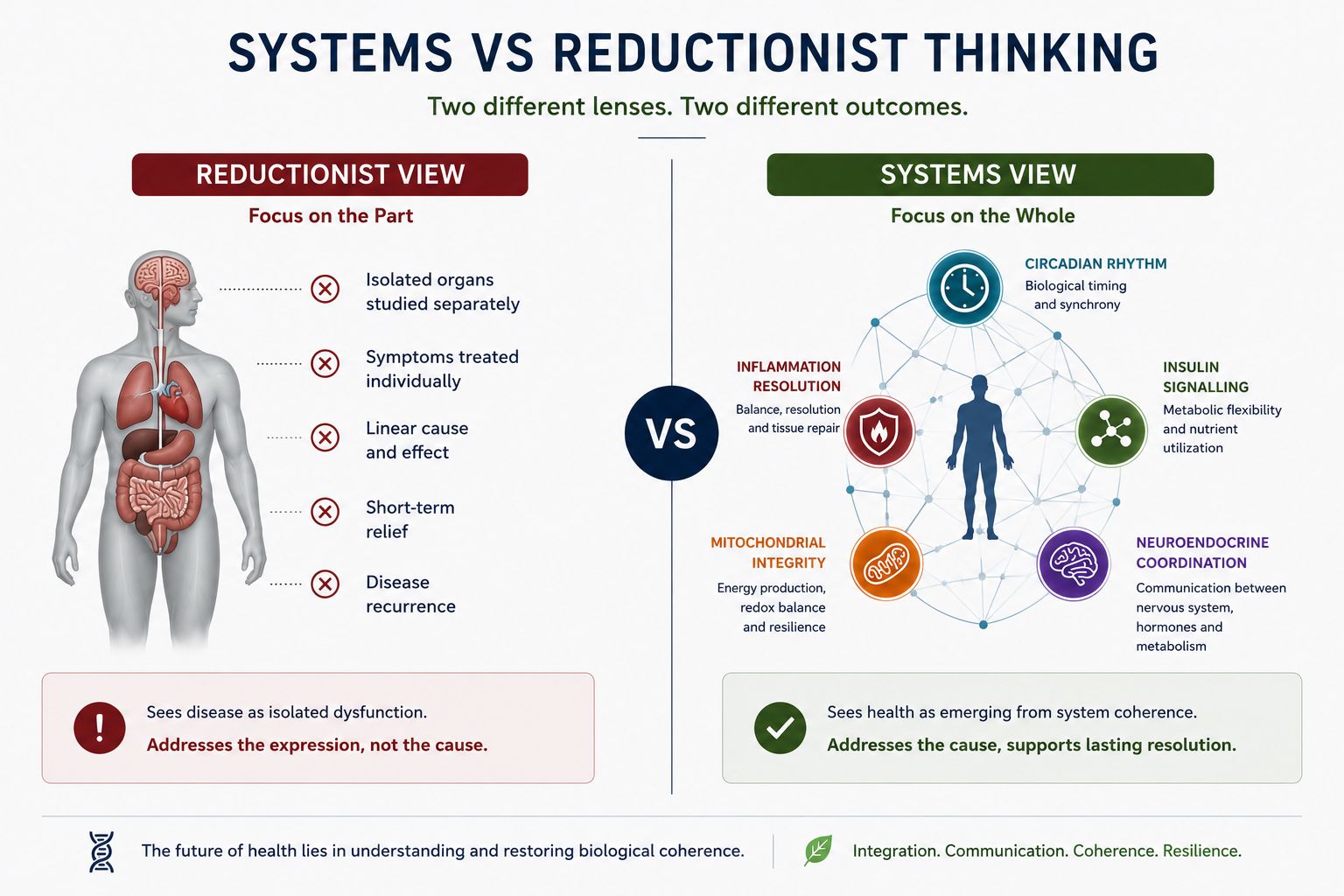
Begin with biology.
Understand the signalling.
Biology is rarely linear. The most visible abnormality is not necessarily the principal driver.
-
Define the Biology
A diagnostic name identifies a recognised condition. It does not always explain the biological processes sustaining it. A formulation architect must therefore look beneath the diagnostic label to understand the tissues, cells, signalling molecules, adaptive responses and environmental influences contributing to the disorder.
-
Identify the Signalling Disturbances
The next task is to identify the principal communication systems that have become dysregulated — persistent inflammatory signalling, inadequate resolution, impaired insulin responsiveness, mitochondrial stress, redox imbalance, circadian disruption, neuroendocrine dysregulation, altered mechanotransduction, extracellular matrix disturbance or impaired tissue remodelling. The objective is not to address every pathway, but to identify those most central to the biological problem.
-
Distinguish Drivers from Consequences
Inflammation may be a driver in one condition and a downstream response in another. Oxidative stress may initiate dysfunction or arise from mitochondrial overload. Pain may protect an injured tissue while contributing to disuse and further functional decline. The most visible abnormality is not necessarily the principal driver.
-
Understand Adaptation
Many responses associated with disease begin as attempts at protection. Inflammation protects injured tissue. Pain limits potentially damaging movement. Insulin resistance may initially reduce nutrient entry into overloaded cells. Fibrosis may reinforce repeatedly injured tissue. The objective should not be to oppose biology indiscriminately, but to understand what biology is attempting to accomplish and why the adaptive response has become trapped.
-
Select Ingredients with Purpose
Only after the signalling architecture has been considered should ingredients be selected. Each ingredient should answer specific questions:
- Which biological function does it support?
- Which signalling pathway does it influence?
- Is the dose biologically meaningful?
- Is the selected form sufficiently bioavailable?
- Does it complement the other ingredients?
- Is it addressing a central biological need or merely adding label appeal?
- Can the intended outcome be evaluated?
The strongest formulation is not necessarily the one containing the greatest number of ingredients. It is the one whose components most coherently serve the intended biology.
-
Verify the Outcome
A formulation becomes scientifically meaningful when its intended effects can be evaluated. Relevant outcomes may include pain, mobility, functional capacity, recovery time, metabolic markers, inflammatory biomarkers, quality of life or validated clinical scores. The formulation architect should know, before finalising the product, what meaningful success would look like.
No formulation is ever permanently final.
Evidence evolves. New delivery systems emerge. Clinical observations reveal strengths and limitations. The objective is not to defend yesterday's ingredient list. It is to move progressively closer to biological coherence and clinical relevance.
Begin with biology. Understand the signalling. Support adaptation. Promote resolution. Select ingredients with purpose. Verify the outcome.
The most rational formulation begins
not with ingredients, but with understanding.