A Systems-Based Framework for Understanding Human Biology

Metabolic Resolution
Framework™

Every scientific discipline requires a framework. A framework does not replace scientific knowledge. It organises knowledge into a coherent way of thinking.

As my enquiry into biological signalling progressed, I recognised that a practical framework was needed to connect physiology, metabolism, inflammation, ageing and chronic dysfunction through a common biological language. This led to the development of the Metabolic Resolution Framework™.

The Framework is founded upon a simple observation: the human body is a highly coordinated biological system in which signalling networks work together to support adaptation, repair and physiological stability. When these systems remain coordinated, biology functions with remarkable precision. When they become persistently dysregulated, adaptive capacity may diminish and chronic dysfunction may emerge.

The Metabolic Resolution Framework™ identifies five interconnected domains central to this coordination.
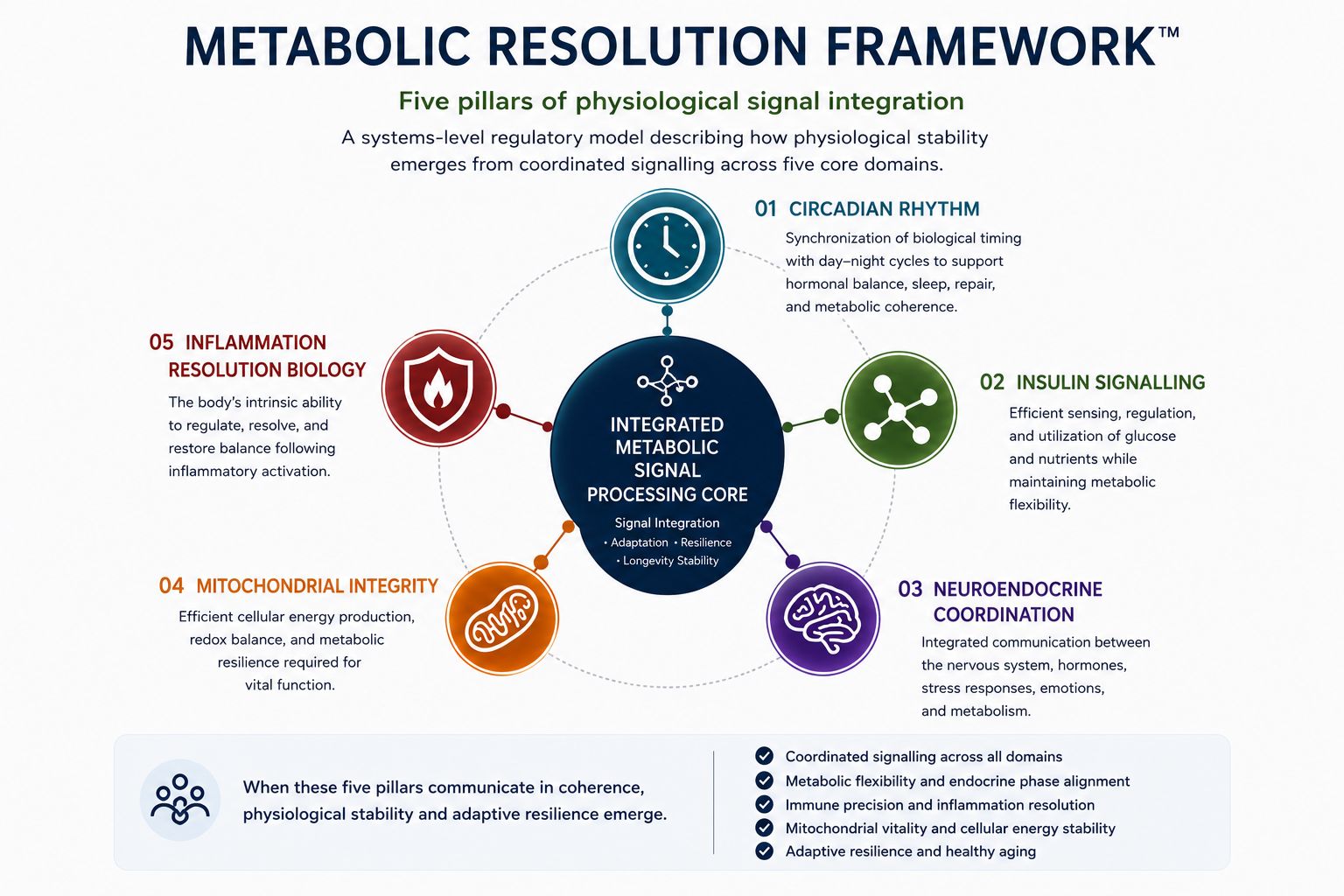
The Metabolic Resolution Framework: five pillars of physiological signal integration — Circadian Rhythm, Insulin Signalling, Neuroendocrine Coordination, Mitochondrial Integrity, and Inflammation Resolution Biology.
Five pillars of physiological signal integration, organised around an integrated metabolic signal processing core.
Five Interconnected Domains

Physiological signal integration.

01

Circadian Rhythm Stability

Time is one of biology's master regulators. Sleep, hormone secretion, immune function, metabolism, mitochondrial activity and tissue repair are all influenced by biological timing. Circadian rhythm stability helps ensure that physiological functions occur at the appropriate time.

02

Insulin Signalling Adaptability

Insulin is far more than a regulator of blood glucose. It is one of the body's principal metabolic signals, influencing energy utilisation, nutrient storage, protein synthesis, cellular growth and tissue repair. Healthy physiology requires an adaptable and appropriately responsive insulin-signalling system.

03

Neuroendocrine Coordination

The nervous and endocrine systems function as an integrated communication network, enabling the body to interpret and respond to internal and external conditions. Persistent stress, disturbed sleep and chronic disease may progressively alter this coordination.

04

Mitochondrial Functional Integrity

Mitochondria are commonly described as the powerhouses of cells, but their role extends far beyond ATP production. They monitor cellular energy, participate in redox signalling, influence inflammation, communicate with the nucleus and help determine how cells respond to stress — fundamental to metabolic resilience and coordinated cellular function.

05

Inflammation Resolution Biology

Inflammation is an essential protective response, helping the body recognise injury, recruit immune resources, remove damaged material and initiate repair. Equally important is the active resolution of inflammation — an organised biological programme that terminates the inflammatory response and restores functional balance.

Not Independent Pillars

One Integrated Network

These five domains are not independent pillars. Each continuously influences the others. Circadian rhythms affect mitochondrial activity. Mitochondrial function influences inflammatory signalling. Inflammation affects insulin responsiveness. Neuroendocrine activity modifies circadian organisation. Insulin signalling alters mitochondrial metabolism.

The interactions are frequently more important than the individual components.

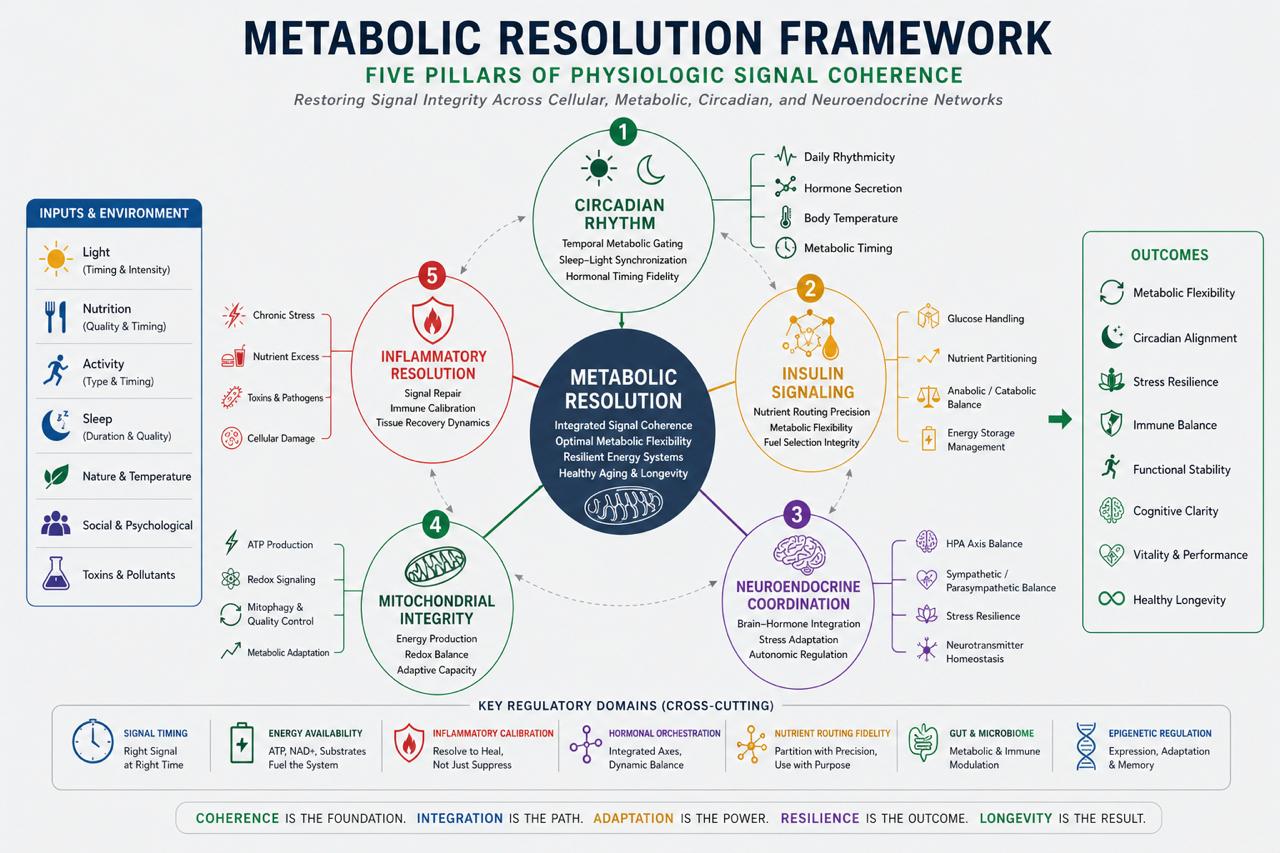
Extended Metabolic Resolution Framework diagram showing inputs and environment, the five pillars, key regulatory domains, and outcomes.
Extended view — inputs and environment, key regulatory domains, and downstream outcomes.

The Metabolic Resolution Framework™ therefore provides a systems-based lens through which biological complexity may be organised into a practical understanding. It also provides the conceptual bridge between biological signalling and rational nutraceutical formulation.

Rather than asking which ingredients are popular, the Framework asks: which biological systems require support in order to recover more coordinated function?

The Framework is not a final or inflexible model. It will continue to evolve as scientific understanding advances. Its purpose is not to provide every answer. Its purpose is to help us ask better biological questions.

Vital Reflection

The purpose of a scientific framework is not
to provide all the answers. Its purpose is to
help us ask better biological questions.