The Language Through Which Life Organises Itself
Every living cell communicates. This simple observation may be one of the most profound truths in biology.
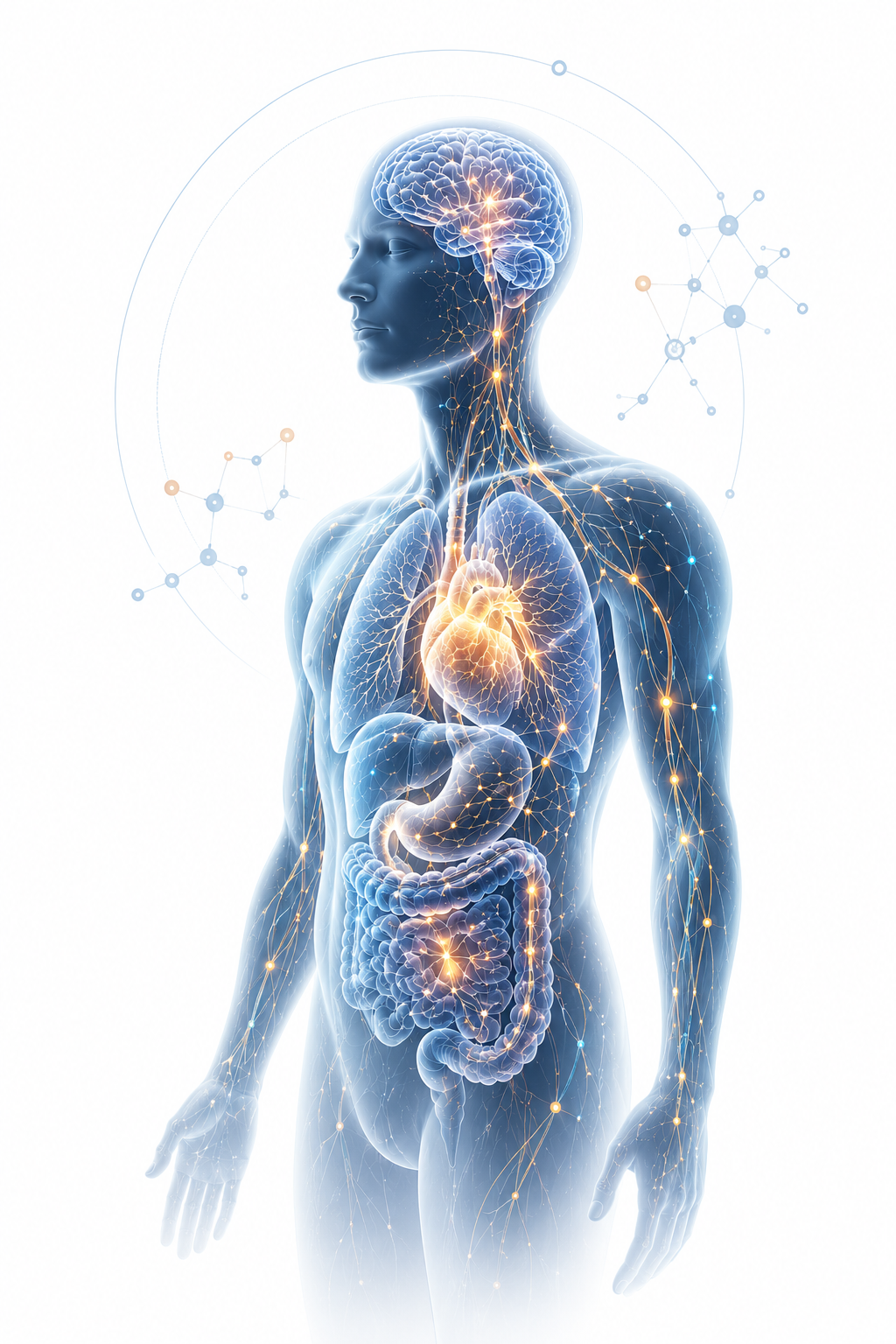
The human body is an extraordinarily sophisticated community of trillions of cells engaged in continuous communication. Every heartbeat, thought, movement, immune response and act of tissue repair depends upon the accurate exchange of biological information.
Cells communicate through hormones, neurotransmitters, cytokines, chemokines, growth factors, lipid mediators, electrical impulses, metabolic cues and mechanical forces. Together, these signalling systems coordinate the countless processes that allow life to exist.
Biological Signalling: From Communication to Coordinated Function — cells receive signals, interpret them through receptors and intracellular pathways, generate appropriate responses and transmit information to neighbouring or distant tissues.
Biology does not speak one language.
Nature has evolved numerous signalling languages, each suited to a different purpose.
- HormonesTravel through the circulation and provide long-distance coordination.
- NeurotransmittersEnable rapid communication through the nervous system.
- CytokinesAllow immune and tissue cells to coordinate defence, inflammation and repair.
- ChemokinesGuide cells towards particular biological locations.
- Growth factorsInfluence cellular development, tissue remodelling and regeneration.
- Lipid mediatorsHelp initiate, amplify and resolve inflammation.
- Electrical signalsCoordinate the nervous system, muscle activity and the rhythm of the heart.
- Metabolic signalsCommunicate the availability of energy and nutrients.
- Mechanical forcesInfluence gene expression, protein synthesis and tissue adaptation.
- Extracellular matrixActs not merely as scaffolding, but as an environment through which cells receive structural, biochemical and mechanical information.
- MitochondriaCommunicate energetic and stress-related information to the nucleus and other cellular systems.
Health Is Dynamic Coordination
Health is not a fixed or motionless state. It is a dynamic process of continuous adaptation. Every moment, the body responds to nutrition, movement, sleep, light, emotional stress, environmental exposure, injury and ageing. Signalling networks continually monitor these conditions and coordinate appropriate biological action.
When communication remains coherent, physiology adapts efficiently. When signalling becomes persistently distorted, adaptation becomes less precise and biological functions may begin to lose coordination. What eventually becomes visible as chronic disease may therefore represent the accumulated consequence of prolonged signalling dysregulation.
Context Determines Meaning
A biological signal does not possess one universal meaning. Its effect depends upon the receiving cell, the receptor through which it is interpreted, the metabolic condition of the cell, the surrounding tissue environment, the presence of other signals, and the timing, duration and intensity of the stimulus.
The same signal may support repair in one context and contribute to dysfunction in another. Biological communication therefore resembles human language. Meaning depends upon context.
From Signalling to Scientific Enquiry
This perspective has profoundly influenced my research. Rather than beginning with ingredients, I begin with the communication that has become dysregulated. I ask: which cells are communicating inaccurately, excessively, inadequately or at the wrong time?
Only after studying that biology do I explore how nutrition and bioactive molecules may support the body's capacity for adaptation, repair and resolution. This signalling-centred perspective is not intended to replace conventional physiology or medicine. It offers a complementary lens.
Anatomy explains the structure of the body. Biochemistry explains its molecular reactions. Genetics explains inherited instructions. Biological signalling helps explain how these elements are coordinated into one living organism.
Biology is not silent. It is engaged in countless conversations every moment of life. To understand those conversations is, perhaps, to understand life itself.
To understand biology, we must first
understand how biology communicates.