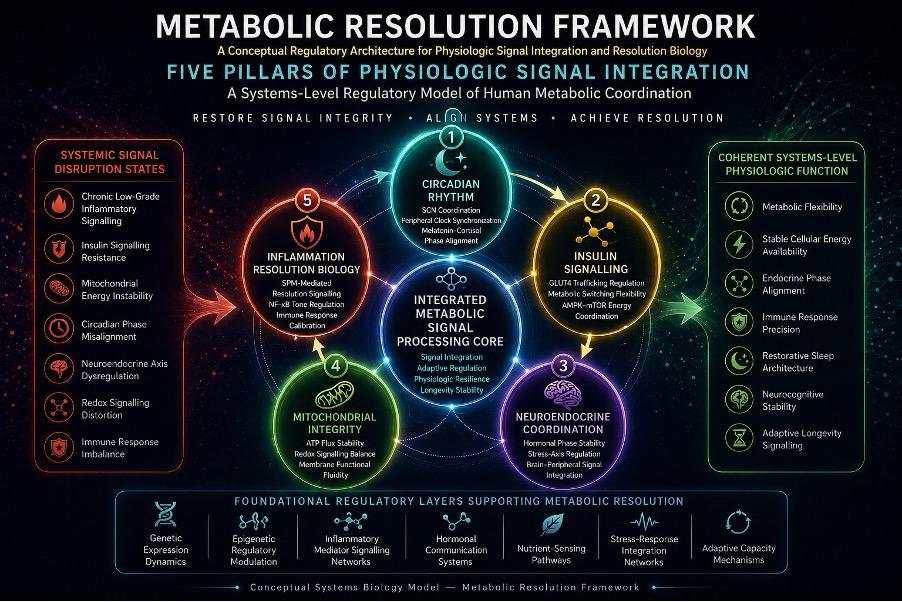
Metabolic Resolution Framework™: A Systems-Level Model for Restoring Physiological Stability
Modern healthcare has achieved remarkable advances in diagnostics and disease management. Yet many chronic conditions continue to be approached through a reductionist lens, where symptoms are isolated, organs are treated independently, and biological systems are examined in relative separation.
The Metabolic Resolution Framework™ offers a different perspective.
This systems-level regulatory model proposes that physiological stability does not arise from the optimal function of a single organ or pathway. Instead, health emerges from the continuous coordination of biological signals across multiple interconnected domains. When these signaling networks function coherently, the body maintains adaptability, resilience, and metabolic flexibility. When communication becomes disrupted, physiological instability begins to manifest, often long before clinical disease becomes apparent.
Moving Beyond the Organ-Centric View of Disease
Traditional models frequently interpret chronic disorders as failures of specific organs or isolated biochemical pathways. While this perspective has contributed significantly to modern medicine, it may overlook the broader regulatory disturbances that precede disease progression.
The Metabolic Resolution Framework™ views chronic conditions as states of disrupted signal integration.
Under this model, symptoms are not merely isolated malfunctions but indicators of underlying communication breakdowns occurring across interconnected physiological systems. Metabolic dysfunction, hormonal imbalance, chronic inflammation, impaired cellular energy production, and accelerated aging may therefore represent different expressions of the same underlying loss of regulatory coherence.
The Five Core Domains of Physiological Regulation
The framework describes physiological stability as emerging from coordinated signaling across five foundational domains:
1. Metabolic Flexibility
Metabolic flexibility refers to the body's ability to efficiently adapt between different energy sources and physiological demands. Healthy systems dynamically regulate nutrient utilization, energy storage, and energy expenditure in response to changing environmental and internal conditions.
When signaling coherence is maintained, metabolic pathways remain adaptable and responsive. When disrupted, metabolic rigidity and energy imbalance may develop.
2. Endocrine Phase Alignment
Hormonal systems operate through carefully synchronized rhythms and feedback mechanisms. Circadian regulation, stress responses, reproductive signaling, and metabolic hormones all depend on precise temporal coordination.
The framework emphasizes that physiological stability requires proper alignment of endocrine signaling phases rather than isolated optimization of individual hormones.
3. Immune Precision
The immune system functions not only as a defense mechanism but also as a regulatory network involved in tissue repair, adaptation, and homeostasis.
Optimal health depends on immune precision: the ability to generate appropriate responses when necessary and resolve those responses efficiently when the threat has passed. Persistent inflammatory signaling or impaired resolution may indicate disruptions in broader systemic communication.
4. Cellular Energy Stability
Every physiological process depends on the reliable production and distribution of cellular energy.
Mitochondrial function, nutrient sensing, oxidative balance, and intracellular signaling work together to maintain energy availability. Stable cellular energy supports adaptation, recovery, cognitive performance, and overall physiological resilience.
5. Adaptive Longevity Biology
Longevity is not merely the extension of lifespan but the preservation of functional adaptability over time.
The framework incorporates biological processes associated with repair, regeneration, stress adaptation, and healthy aging. These mechanisms enable organisms to maintain physiological coherence despite environmental challenges and cumulative biological stress.
Resolution Physiology: A New Therapeutic Perspective
A central concept within the Metabolic Resolution Framework™ is resolution physiology.
Rather than focusing exclusively on suppressing symptoms, resolution physiology seeks to restore the signaling conditions that allow the body to self-regulate effectively. This approach emphasizes the re-establishment of communication integrity between biological systems, enabling adaptive responses and long-term stability.
In this context, interventions are evaluated not only by their ability to alleviate symptoms but also by their capacity to support systemic regulatory coherence.
A Foundation for Adjunctive Metabolic Interventions
The Metabolic Resolution Framework™ provides a mechanistic foundation for developing adjunctive metabolic interventions that align with the body's natural regulatory architecture.
By focusing on signaling integrity, practitioners and researchers can explore strategies that support:
- Improved metabolic adaptability
- Enhanced endocrine synchronization
- Precise immune regulation
- Stable cellular energy production
- Healthy aging and resilience
This systems-oriented approach encourages a shift from managing isolated dysfunctions toward restoring the conditions that enable integrated physiological performance.
The Future of Systems-Based Health
As biological research continues to reveal the complexity of human physiology, there is growing recognition that health cannot be fully understood through isolated pathways alone.
The Metabolic Resolution Framework™ contributes to this evolving perspective by providing a structured model for understanding how coordinated signaling drives physiological stability. By viewing chronic disease through the lens of regulatory coherence and resolution physiology, it offers a pathway toward more integrated, adaptive, and sustainable approaches to human health.
Ultimately, health may be less about controlling individual symptoms and more about restoring the communication networks that allow the body to function as a unified system.